We use cookies to ensure a comfortable browsing experience on our website and to continuously improve its features, performance, and usability through traffic analysis. Learn more.

(Updated: August 2026)
Are you unsure which glue will actually lock your yarn in place without turning your tufted rug into a stiff, cracked board? Read on to learn what professional tufters use, what to avoid, and how your tufting cloth choice changes everything. This guide walks you from first backing coat to final finish, so your rug looks clean and lasts.
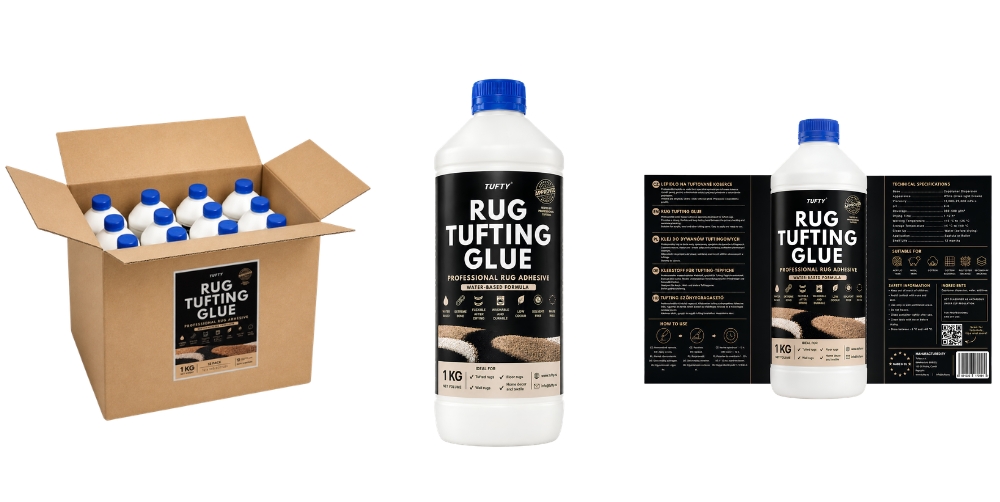
Why glue choice matters more than you think
Tufting creates a dense forest of yarn pushed through a foundation cloth. That cloth holds the yarn temporarily through tension and friction, but it is the glue that turns your tufted piece into a durable textile. Tufting glue choice has an impact on the following factors.
Durability under foot traffic, flexibility (whether the rug can be rolled), edge finishing, odor and indoor comfort while curing, how well a secondary backing bonds, and how cleanly you can carve and shear your pile. The wrong adhesive can still look fine on day one, then gradually release yarn, crumble, crack, or delaminate when the rug is moved, vacuumed, or exposed to humidity changes.
A useful way to think about it is this. A tufted rug usually needs two bonding jobs. First, you need to lock the yarn into the primary backing. Second, you may want to bond a secondary backing for structure, comfort, and a clean underside. One product can sometimes do both, but not always and that's where most beginner failures happen.
The three glue jobs in tufting
- Primary backing coat: This is the most important layer. It penetrates the base of the yarn tufts on the back side and cures into a flexible film that prevents tuft pull-out.
- Secondary backing bond: This adheres felt, canvas, or other backing to the cured primary coat. If you are choosing the right tufting glue backing solution, this layer must bond fabric-to-glue reliably without soaking through or refusing to stick.
- Edge and detail finishing: This includes sealing edges, binding cloth, neatly tucking and securing corners, and sometimes attaching nonslip elements. The best adhesive here is often different from the best primary coat.
Why latex is popular for tufting
Latex is one of the most commonly used adhesives in tufting, particularly for securing the tufts in hand-tufted rugs. Its versatility, flexibility, and strong adhesive properties make it a top choice for many crafters. Latex can be found in both natural and synthetic forms, each with its own set of advantages and considerations.
Natural latex
Natural latex is derived from the sap of rubber trees, making it an environmentally friendly option. It's known for its strong adhesive qualities, allowing it to penetrate the fabric deeply and secure the yarn effectively. This natural glue is biodegradable, sustainable, and generally safe for both the environment and users, although it can cause allergic reactions in some individuals.
Synthetic latex
On the other hand, is chemically produced and often used in industrial applications. While it tends to be more cost-effective and offers faster drying times, it may contain volatile organic compounds (VOCs) and other chemicals that could be harmful over time. This type of latex is less flexible and can degrade faster than natural latex, leading to potential issues with durability.
Natural vs. synthetic latex
Natural latex is harvested through a process called tapping, where the sap is collected from rubber trees. This sap is then processed into liquid latex, which is ideal for tufting due to its natural adhesive properties. It is highly valued for being a renewable resource, making it an eco-friendly choice for those conscious of their environmental impact.
Synthetic latex, created from petroleum-based chemicals, is often used for more industrial purposes. It provides a strong, fast-setting bond but lacks the flexibility and eco-friendliness of its natural counterpart. The environmental impact of synthetic latex is also a concern, as it is not biodegradable and can contribute to pollution.
Best practices for using latex in tufting
When using latex for tufting, whether natural or synthetic, there are a few best practices to ensure optimal results. Latex glue should be applied evenly across the back of the fabric to secure the tufts and maintain the rug's shape. The flexibility of latex makes it easier to roll and transport the finished product, which is ideal for shipping or moving rugs.
Natural latex is often preferred for high-quality, hand-crafted rugs due to its sustainability and non-toxic nature. It works well on various surfaces, from hardwood floors to carpets, and does not require additional backing to prevent slipping. However, those with latex allergies should opt for alternative adhesives that do not contain latex proteins.
Alternative adhesives: Universal flooring adhesives and carpet glues
For those looking for alternatives to latex-based adhesives, universal flooring adhesives and special carpet glues are excellent options. These adhesives are designed to be flexible and durable, making them suitable for securing tufted projects. Universal flooring adhesives can bond with various surfaces and materials, ensuring a strong hold that accommodates the natural movement of carpets or rugs.
Carpet glues are specifically formulated for securing fibers and backing, providing a reliable bond that can withstand heavy use and foot traffic. These alternatives are especially useful if you're working with materials that might not react well with latex or if you're concerned about potential latex allergies.
Hot glue for tufting
Hot glue is fantastic for edge finishing, quick fixes, and clean folds. Especially when you're binding edges, attaching edging tape, or securing backing corners. But it is not ideal as the main adhesive layer for a tufted rug.
Hot glue cools fast, can create lumps, and can become rigid in thick applications. Over time, a fully hot-glued backing can feel uneven and may not handle bending or temperature shifts as gracefully as latex.
Choosing the right glue for tufting
Selecting the appropriate glue for your tufting project depends on the type of work you're doing and the materials involved. If you're working on a high-traffic area rug, you'll need an adhesive that offers strong bonding and durability.
Best glue for rug tufting
Natural latex is often the best choice for tufting rugs thanks to its durability, flexibility, and more environmentally friendly profile. It creates a strong bond while allowing the rug to remain soft rather than becoming overly stiff. This is one of the main reasons why latex adhesive is so widely used for hand-tufted rugs and other floor pieces.
For projects requiring quick drying times and a strong hold, synthetic latex can also be a suitable option. Carpet adhesives such as Roberts 3095 are another popular choice among tufters because they are highly durable and easy to find, although they can be messier to apply and often have a stronger smell.
Other flooring adhesives, such as MAPEI Ultrabond ECO 420, may also work well and are valued by some makers for their secure hold and moisture resistance.
For decorative tufted pieces or wall art that will not face heavy wear, simpler options such as Elmer's Glue can also be sufficient. While it is more affordable and easy to apply, it dries much stiffer, so it is generally not the best choice for rugs intended for regular use.
Universal flooring adhesives and carpet glues therefore remain practical alternatives, especially for those who are sensitive to latex or working with different materials, but natural latex is usually seen as the top overall option for tufted rugs.
Dispersion tufting glue – holds like latex, without the latex price
Alongside latex, more and more tufters are switching to dispersion tufting glue. Functionally it does the same job as latex glue for rugs – it cures into a flexible film that locks the yarn firmly into the backing cloth – but it typically costs about half as much. That is exactly why, after years of testing, it is the glue we use and sell at Tufty.
What a quality dispersion glue gives you:
- Flexible for years – the cured layer stays supple, so the rug can be rolled and shipped without cracking. We have rugs backed with our glue that are still flexible after 5 years.
- Washable rugs – once fully cured, the rug survives a gentle 30 °C machine wash, because the glue keeps the fibers locked in place.
- Easy application – spread gently with a spreader or a piece of stiff cardboard in one continuous coat; it doesn't drag at your loops the way thicker latex compounds can.
- Latex-free – no latex proteins, so it's safe for makers with latex allergies.
Exact drying times, storage and safety guidance are available in our tufting glue documentation.
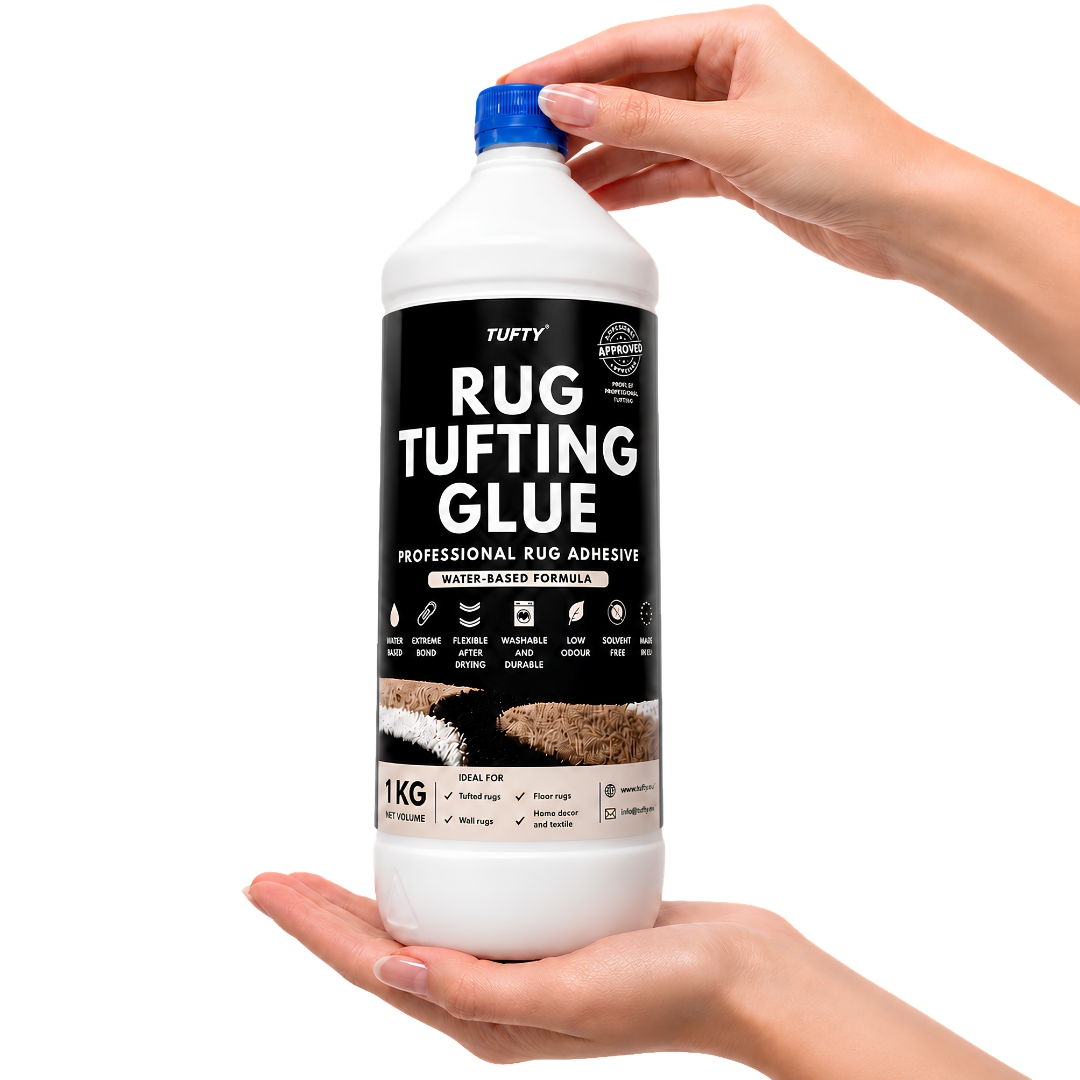
Tested on real tufted rugs
Rug Tufting Glue by Tufty – the dispersion glue we selected and have been testing on tufted rugs for years. Flexible, washable, with full instructions included and fast EU shipping.
How long does tufting glue take to dry?
Drying time depends on adhesive chemistry, thickness, and the environment.
Latex compounds may feel dry on the surface while still curing underneath. In a warm, well-ventilated room, you might reach a workable touch-dry stage relatively quickly, but full cure often takes longer. Thicker coats, cooler temperatures, and higher humidity can extend drying substantially.
Important: "Dry to the touch" is not the same thing as "fully cured." A backing can feel dry, then still soften or shift if you bend it aggressively too soon. If your goal is a floor rug that lasts, give the glue the time it needs to cure properly and avoid rolling or folding the rug until the backing feels uniformly stable.
Conclusion:
Choosing the right tufting glue for your rug is a critical step in ensuring that your work is both beautiful and durable. Natural latex offers a sustainable, flexible, and safe option for most tufting needs, while synthetic latex glue for tufted rugs provides greater strength and faster drying times but comes with environmental drawbacks. Universal flooring adhesives and carpet glues serve as versatile alternatives that cater to various needs and material types.
By understanding the differences between these adhesives and considering the specific requirements of your project, you can select the glue that best suits your needs, helping you create tufted pieces that stand the test of time.
And if you'd rather skip the guesswork: our tufting glue category carries the dispersion glue we've tested directly on tufted rugs – it holds like latex, you just don't pay the latex premium.
Tufting glue FAQ
Yes. A dispersion glue formulated for tufting cures into the same kind of flexible, fiber-locking film as latex, at roughly half the cost, and contains no latex proteins. That's why it's the glue we use ourselves – you'll find it in our tufting glue category. Yes – if you use a flexible glue and let it cure fully, the rug survives a gentle 30 °C machine wash. Just watch edges finished with hot glue, as those can come loose in the wash. For floor rugs we recommend one – a secondary backing adds structure and gives the rug a clean underside. For wall pieces you can skip it and leave the cured glue layer as the finished back. Can I use dispersion glue instead of latex for tufting?
Is a glued tufted rug washable?
Do I need a secondary backing cloth?