We use cookies to ensure a comfortable browsing experience on our website and to continuously improve its features, performance, and usability through traffic analysis. Learn more.

Have you ever wondered whether a tufted rug with loops or with cut fibers is the better choice for your next tufting project? In this article, you will learn everything about the technical differences and practical advantages of both options. In this article, we further build on our previously well-read article exploring cut pile and loop pile. Read on to make the perfect decision for your creative work.
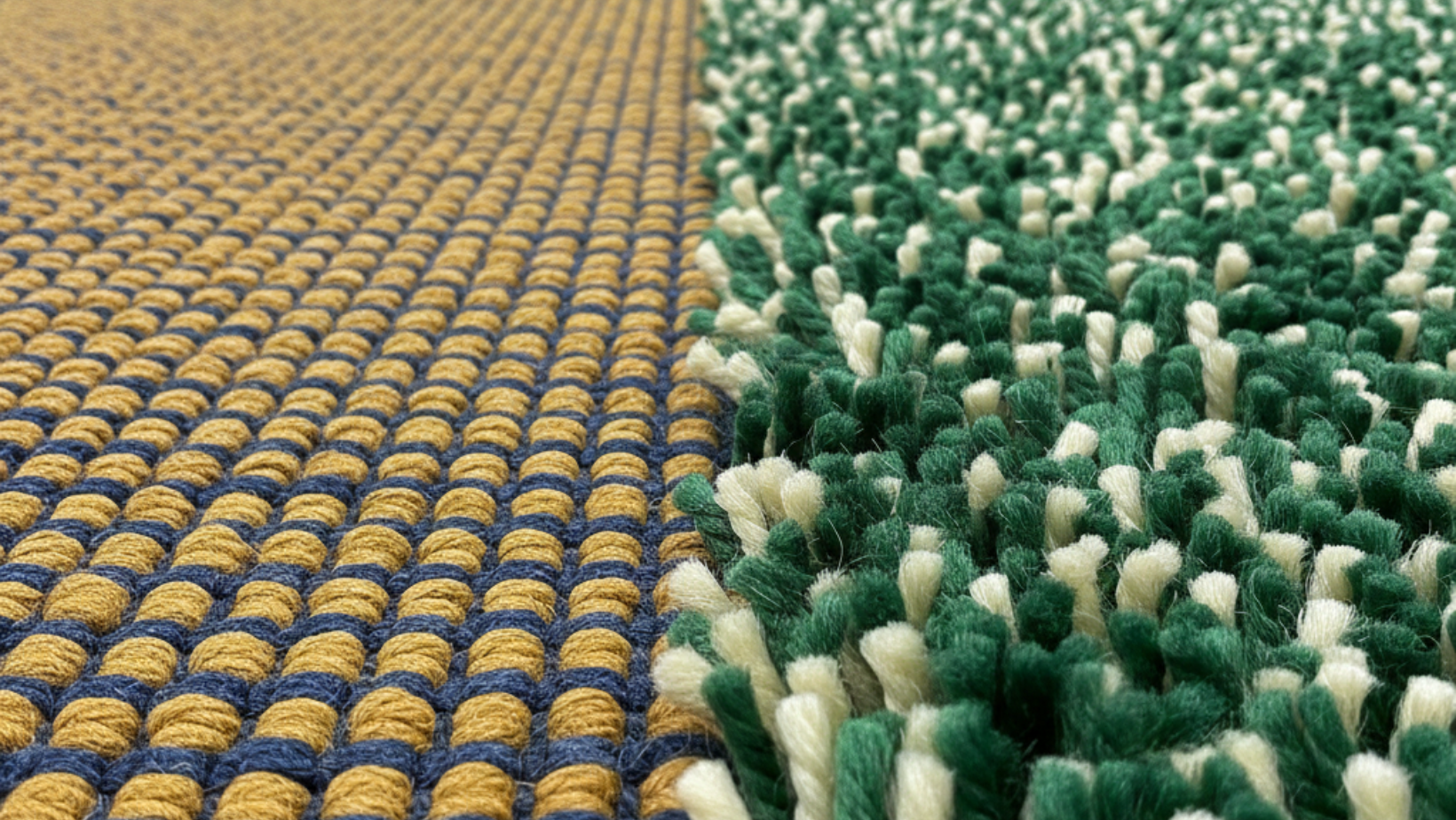
The Mechanics Behind Loop Pile and Cut Pile in Tufting
To understand which style is best suited for your rug, we need to look at how tufting machines work. In tufting, the yarn is pushed through a backing fabric with a needle. When you use a Loop Pile tufting machine, the machine simply pulls the needle back out and leaves behind a continuous chain of loops.
This structure is mechanically very stable because the fibers are not interrupted. The result is a surface that feels firm and has a very uniform visual structure. Many professional carpet manufacturers appreciate this method for floor coverings that must withstand heavy foot traffic.
In contrast, a Cut Pile tufting machine has an integrated pair of scissors. Each time the needle pushes the yarn through the fabric, the blade immediately cuts the loop open. This creates two loose ends per stitch that stand upright. This open fiber structure provides the typical fluffy feel that we often associate with high-quality living room rugs. Since the fibers in Cut Pile are more movable, they absorb light differently and often appear deeper and more saturated in color than the closed loops of Loop Pile. If you are unsure which device suits you best, our blog article Which Tufting Gun Should I Choose will help you decide.
Durability and Longevity Comparison
A decisive factor in choosing between the two is where the rug will be placed. Loop Pile rugs are known for their exceptional durability. Because the loops are closed, they can absorb pressure better without the fibers being permanently flattened. This makes them ideal for hallways or commercial spaces. However, there is a small disadvantage in the risk of pulled threads. If you have pets with claws, they may get caught in the loops and pull the yarn out of the fabric. For such projects, a sturdy tufting frame is the most important foundation to maintain the necessary tension.
Cut Pile rugs, on the other hand, are more prone to so-called pilling or the appearance of walkways over a long period of time. Because the fibers are open at the top, they can bend to the side under heavy load. Nevertheless, the comfort factor of Cut Pile is unmatched.
For wall hangings or rugs in the bedroom, where people often walk barefoot, the soft feel is usually more important than extreme durability. A major everyday advantage of Cut Pile is that stains can often be removed more easily, as the fibers stand individually and the cleaning solution can penetrate more deeply.
Design and Aesthetics Possibilities in Rug Tufting
The visual impact of both types differs significantly and influences the final design of your artwork. With Loop Pile, you can create very precise geometric patterns and clean lines. The texture appears modern and rather minimalist.
However, it is more difficult to blend complex color gradients with Loop Pile, as the loops create a very defined boundary. Many artists deliberately use Loop Pile to create high-contrast relief structures by combining different loop heights.
The Cut Pile is the favorite for anyone who enjoys working with details. After tufting, you can refine a Cut Pile rug with shearing tools to create perfectly even surfaces or three-dimensional sculptures. Through carving, meaning cutting in contours, details can be emphasized that would never appear as sharp in a loop structure. If your goal is a shaggy look or a rug with extremely fine color gradations, the open fiber of Cut Pile offers the flexibility required for these artistic techniques.
Which Yarn Is More Suitable for Which Technique?
The choice of yarn plays a crucial role in the final result for both techniques. For Loop Pile, it is recommended to use yarns that have good intrinsic stability and elasticity. Wool blends are excellent here because they maintain the shape of the loop over many years. A yarn that is too soft could cause the loops to collapse into each other and make the pattern appear blurred. Make sure that the yarn has a consistent thickness so that the loop pattern remains harmonious.
With Cut Pile, you have a bit more freedom in choosing yarn. Acrylic yarns or pure cotton are often used here to achieve maximum softness. Since the fibers are cut, it is important that the yarn does not shed excessively.
A high-quality, tightly twisted yarn ensures that the cut edges remain clean and that the rug does not lose its volume even after shearing. Many tufters also combine both techniques in one piece to create exciting visual effects by alternating between shiny and matte fibers.
Tools and Maintenance of Tufting Machines
The handling of the machines also differs slightly in terms of maintenance. A Cut Pile machine requires more attention because the moving scissors must be oiled and sharpened regularly. If the blade becomes dull, it will tear the yarn rather than cut it cleanly, resulting in an uneven surface appearance. You must ensure that the scissor position is always correctly adjusted to guarantee consistent pile heights.
The Loop Pile machine is mechanically somewhat simpler in design, as there is no cutting mechanism. Here, the challenge lies more in keeping the yarn tension constant. If the yarn is too loose, the loops may become uneven in size or even pull back out of the fabric before the carpet glue is applied to the back. For beginners, Loop Pile is often a bit easier to handle, while Cut Pile can speed up the workflow thanks to its automatic cutting function, since manual trimming of the thread at the end of a line is no longer necessary. If you want to get started right away, a tufting starter kit is the best choice.
Summary on the Difference Between Loop Pile and Cut Pile
The essential difference between Loop Pile and Cut Pile lies in the construction of the fibers, with Loop Pile using closed loops and Cut Pile using cut, open yarn ends. While Loop Pile stands out for its robustness and suitability for heavily used surfaces, Cut Pile scores with a soft surface and better possibilities for detailed finishing.
Your choice should therefore depend on whether durability or comfort and artistic design are more important to you. Both techniques offer unique aesthetic advantages for individual rug projects. Ultimately, the intended use of the rug determines which structure is the right one.