We use cookies to ensure a comfortable browsing experience on our website and to continuously improve its features, performance, and usability through traffic analysis. Learn more.

Have you ever wondered what actually makes those thick, luxurious rugs so expensive and why so many artists and designers are suddenly obsessed with making them by hand? Read on to discover the full story behind tufting, one of the most fascinating textile techniques that combines industrial heritage with contemporary craft.
What is tufting and where does it come from?
Tufting is one of those crafts that sounds technical at first but becomes completely intuitive once you understand its logic. Whether you are drawn to it as a creative hobby or as a potential business, the history and principles behind it are well worth understanding before you pick up your first tool.
If someone asks you what tufting is and you are not quite sure how to explain it, our tufting meaning page has the clearest definition we could put together.
So, what is tufting anyway?
Tufting is a textile technique in which yarn is pushed through a base fabric using a needle, creating loops or cut pile on the surface. The result is a dense, textured material that can be shaped into rugs, wall hangings, cushions, and a wide range of decorative objects.
The word itself comes from the Old English term for a small cluster of threads. Today, it refers to an entire family of methods, from slow hand-stitching all the way to fast electric tufting guns that allow you to cover large areas in a fraction of the time.
What makes tufting special is the way it builds texture from the ground up, row by row, loop by loop, until a design emerges with real physical depth and weight. You are not painting a surface or printing onto fabric. You are constructing it, fibre by fibre, from nothing.
A short history of tufting
Tufting has roots going back centuries, but its modern industrial form took shape in the early 20th century in Dalton, Georgia, where local women began using modified sewing machines to mass-produce tufted bedspreads.
The technique proved so efficient that Dalton eventually became the carpet capital of the world, responsible for a significant share of global carpet production.
The tufting gun as we know it today came later, born from the same mechanisation principles but shrunk down into a handheld device. This made the technique accessible to individual makers for the first time, opening it up beyond factories and into studios, bedrooms, and art schools across the world.
From craft to contemporary art
In recent years, tufting has made a sharp turn from industrial process to contemporary art medium. Artists and designers worldwide have adopted it as a way to create tactile, large-scale works that blur the line between decorative craft and fine art.
Custom tufted rugs now regularly sell for hundreds or even thousands of euros, particularly when they feature intricate designs, hand-dyed yarns, or sculptural three-dimensional surfaces.
The craft has found a devoted community across Europe and beyond, driven in large part by the visual satisfaction of watching a design take shape in real time. If you are curious whether tufted rugs are the right choice for your own space, that is a whole topic worth exploring in its own right.
The tufting process explained
Understanding how tufting actually works will help you make better decisions about tools, materials, and the kind of projects you want to pursue. The process is more structured than it might appear at first glance, but it is also deeply rewarding once you find your rhythm.
A quick introduction: loops, lines, and texture
At its core, tufting works by driving yarn through a backing fabric in rows. The tufting gun moves along the surface, and with each pass the needle penetrates the cloth and deposits yarn in either a loop or cut form.
Loop pile leaves the yarn in a continuous arch, giving a firm, structured surface that is highly durable and well-suited to areas with heavy foot traffic.
Cut pile severs each loop immediately, leaving soft upright fibres that create a fluffy, plush feel. The kind you associate with a luxurious living room rug.
The distinction between these two outcomes matters enormously for the final look, feel, and durability of the piece. Understanding loop pile vs cut pile tufting in depth is one of the most valuable things a beginner can do before starting their first project.
How does a tufting project actually work?
A typical tufting project follows a clear sequence of steps, each of which has its own challenges and satisfactions.
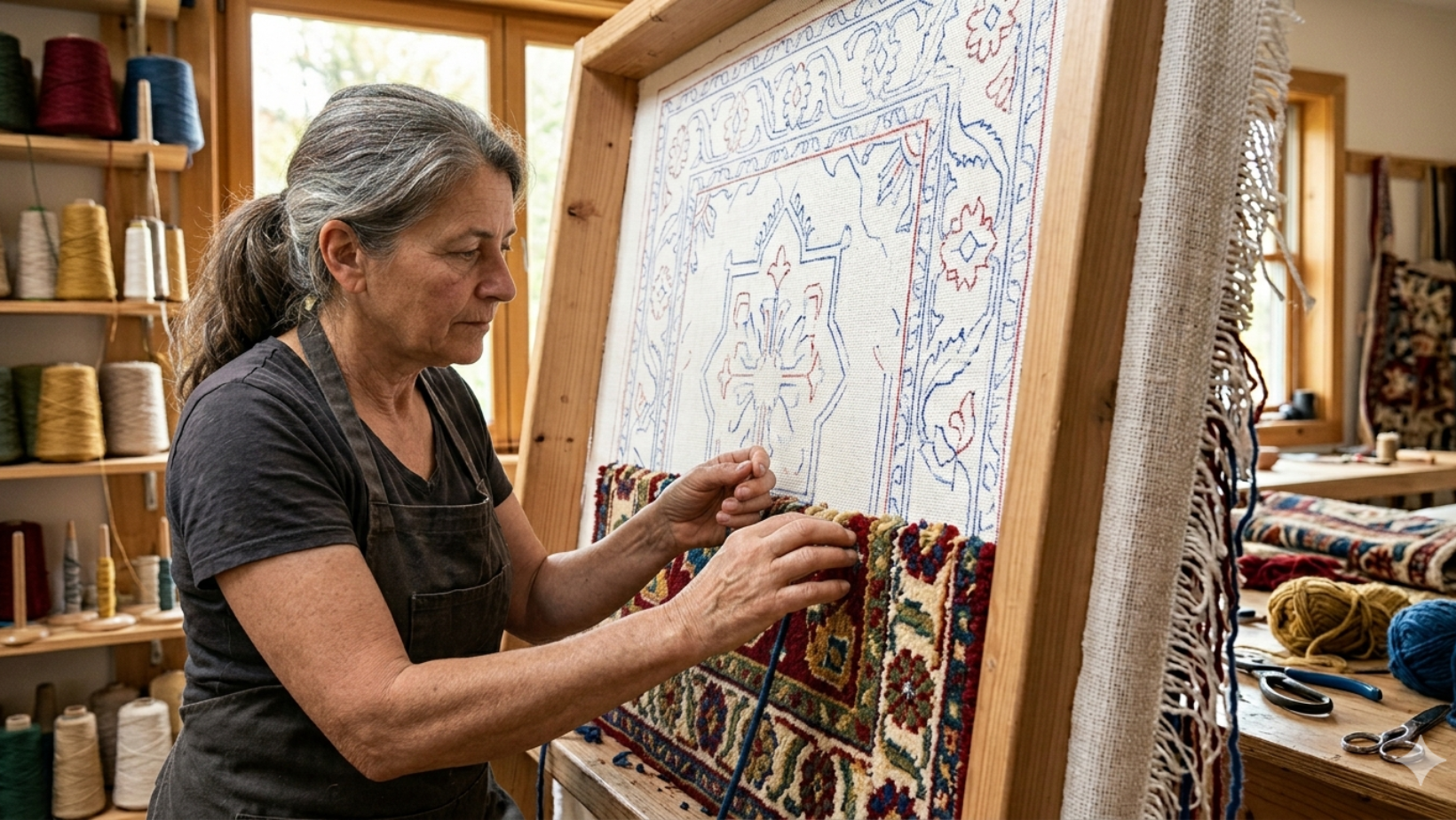
First, a design is drawn or projected onto the backing fabric, which is stretched tightly across a frame. This is where tools like a projector become essential for accurate, large-scale work. Getting this step right saves an enormous amount of time and frustration later. Once the design is mapped out, tufting begins in earnest.
The gun moves steadily along the outlines and fills in each section, with the maker switching yarn colours as needed. After tufting is complete, the back of the piece is coated with a carpet adhesive to lock the yarn in place.
A secondary backing cloth is then added for stability and to protect the underside. Finally, the surface is trimmed, shaped, and finished and this is where a piece truly comes to life.
Punch needle vs. tufting: which one is right for you?
Punch needle and tufting are closely related but distinct techniques. Punch needle is a slower, more meditative process using a handheld needle that you push through the fabric by hand, stitch by stitch. It gives you extremely fine control and is ideal for small, detailed pieces or for makers who enjoy a quieter, more tactile experience.
Tufting with a gun, on the other hand, is significantly faster. A tufting gun can cover large areas in minutes, making it practical for rug-sized projects and for anyone who wants to work at scale.
The speed also means you can experiment more freely, try bolder colour combinations, and iterate on designs without spending weeks on a single piece.
Both approaches have their place, and many experienced makers practise both depending on the size and intent of the project at hand.
Tools, materials and how to get started
Getting started with tufting does not have to be overwhelming. The core toolkit is straightforward, and once you have the basics in place, you can build from there at your own pace.
What do you need to start tufting?
The essential starting point is a small set of specialised materials. You need a backing fabric, most commonly monks cloth or a polyester tufting cloth, stretched tightly across a tufting frame to keep it under the right tension. You need a tufting gun, yarn, carpet adhesive for finishing, a secondary backing cloth, and scissors or a trimmer for the final shaping.
The quality of these materials makes a direct difference to the outcome. A well-tensioned frame, for example, is not just a convenience but a technical necessity.
Without consistent tension, the tufting gun skips, the pile becomes uneven, and the finished piece loses its structural integrity.
Essential tools for tufting: a beginner's guide
Here is a clear breakdown of the key tools you will need and what each one does.
|
Tool |
Purpose |
Notes |
|
Tufting gun |
Pushes yarn through backing fabric |
Available in cut pile, loop pile, or 2-in-1 versions |
|
Tufting frame |
Holds the backing fabric under tension |
A solid frame is non-negotiable for good results |
|
Backing fabric |
The base through which yarn is pushed |
Monks cloth and polyester tufting cloth are most common |
|
Tufting yarn |
Creates the pile surface |
Wool, acrylic, and cotton all work well |
|
Carpet adhesive |
Locks yarn in place after tufting |
Applied to the back before secondary backing |
|
Rug trimmer |
Shears and shapes the pile |
Essential for cut pile finishing and sculpting |
|
Secondary backing |
Protects the underside of the finished piece |
Adds durability and a clean, professional finish |
For beginners, a complete tufting starter kit is often the most practical choice, as it bundles the most important items together and removes the guesswork from assembling your first setup.
Tips for getting started
A few things make the early stages of tufting significantly easier. Work with good lighting so you can see the backing cloth weave clearly. Start with a simple, bold design rather than something highly detailed. Clean shapes and strong colour contrast are much more forgiving when you are still learning how the gun behaves in your hands.
Keep your movements slow and steady, especially on curves. Consistent pressure against the backing is more important than speed. Speed comes naturally with practice.
Choosing the right backing fabric is also more important than it might seem at first. If your cloth starts to tear during tufting, that is usually a sign of tension or technique issues. The Tufty blog article on why tufting cloth rips addresses this directly and is worth reading before you start your first project.
And if you are wondering which specific projects are worth tackling at the beginning to build your skills as efficiently as possible, the guide on the first three projects that will teach you 80% of tufting is an excellent place to start.
Benefits of tufting and why it's trending now
The rise of tufting is not accidental. It sits at a very particular intersection of creativity, accessibility, and genuine market demand that makes it compelling both as a hobby and as a serious craft practice.
Benefits of tufting in textile and design
From a design perspective, tufting offers benefits that few other textile techniques can match. The key advantages include:
- Speed at scale: a tufting gun covers ground far faster than hand-knotting or weaving, making large pieces entirely practical for individual makers
- Design flexibility: you can work from any drawing, projection, or template and replicate complex patterns with reliable consistency
- Tactile depth: the physical texture of a tufted surface adds a dimension that printed or woven textiles simply cannot achieve
- Sculptural potential: with carving and shearing, cut pile rugs can be shaped into three-dimensional compositions of real artistic complexity
- Durability: properly finished tufted pieces hold up extremely well, particularly those made with quality tufting yarn and a secure secondary backing
- Customisation: every piece is unique, which is increasingly valued in a market saturated with mass-produced home goods
Who is tufting for?
Tufting attracts an unusually broad range of people, which is part of what makes the community around it so interesting. Interior designers use it to create bespoke statement pieces for clients.
Artists use it as a fine art medium with genuine gallery presence. Small business owners sell custom tufted rugs and commissions online, often building significant followings around their work.
And a growing number of people simply do it for the pleasure of making something with their hands. Something tangible, something that will last, something that carries real aesthetic intention.
There is no specific background required to start. Complete beginners regularly produce impressive results within their first few projects, and the learning curve is steep in the best possible way. You improve quickly, and each project teaches you something the previous one could not.
If you are wondering how to set up a proper space for this kind of work, the guide on setting up a tufting studio covers everything from frame placement to lighting in practical, actionable terms.
Final thoughts: just give it a go!
So, what is tufting in textile? It is the technique behind some of the most expensive and sought-after rugs in the world, a centuries-old industrial method that has found a second life as a contemporary art form, and one of the most accessible creative skills you can pick up today.
Tufting combines speed, creative freedom, and genuine tactile satisfaction in a way that very few other crafts manage. Whether you want to make a small decorative wall piece or a large custom rug for a client, the process is the same at its core. The only real requirement is to start.